
'Like Nehru, too, Modi has found dealing with Beijing more and more difficult and has adopted an increasingly assertive approach towards managing India's northern neighbour.'

It accounted for over a third of foreign direct investment flows into India between 2000 and 2015
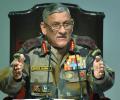
Gen Rawat said the world looks at India as a country that can balance the rise of China in the region as it was showing its 'assertiveness'.

These natural wonders are all under threat.

He also emphasised that those giving shelter to terrorists and using them as political instruments must be condemned, an apparent reference to Pakistan.

'There is no parallel in UN history of an individual terrorist being bailed out by a world power,' points out Brigadier S K Chatterji (retd).

It's a packed 5-nation, 9-day, visit for Prime Minister Modi as he heads to Uzbekistan, Kazakhstan, Kyrgyzstan, Turkmenistan and Tajikistan, apart from Ufa in Russia.

India's negotiating posture at the multilateral negotiations should be aligned with a significantly transformed development strategy domestically.' 'The positions the country takes at the negotiations will then carry credibility, says Shyam Saran, former foreign secretary and India's chief negotiator on Climate Change 2007-2010.
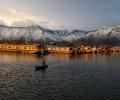
Read on to find out if your favourite destination made it to the list!
Seeking to boost the strategic ties, India and the US finalised the text of the Logistics Exchange Memorandum of Agreement.
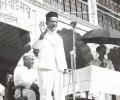
Savarkar believed Swarajya is more than the mere geographical independence of a stretch of earth called India. There was no point in fighting and sacrificing one's life for a Swarajya (mere territorial independence) at the cost of our Svatva (self-existence) or Hindutva itself! A revealing excerpt from Uday Mahurkar and Chirayu Pandit's Veer Savarkar: The Man Who Could Have Prevented Partition.

'He was always opposed to a form of nationalism that was narrow, selfish and arrogant.' 'He will always remain a beacon of inspiration for freedom-loving people across the world and for movements of resistance against oppressive State power.'

Prime Minister Narendra Modi's ambitions abroad may run the risk of foundering on constraints at home.

The IAF chief also said Pakistan has become a pawn of Chinese policy and its dependence on China would increase further in future. He said India needs to understand the interplay of some major events in its vicinity that would impact the security scenario of the region.
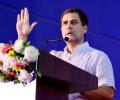
"The Congress ideology...the ideology it follows has been existing in India for thousands of years. Just like the RSS has its icons, the Congress has its own icons... they are different icons. But, we have them, it is about bringing this ideological ocean and allowing our people to swim in it," he said.

'We are confident that the US manufacturing industry will be able to take advantage of the US-India Investment Initiative to effectively support our goals of assisting in the development of three Indian cities -- Ajmer, Vishakhapatnam and Allahabad -- where the United States will be the lead partner,' Senators Warner and Cornyn told Obama.
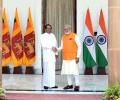
In the aftermath of the Easter Sunday terrorist attacks, allegations have been made that the Muslim militants in Sri Lanka draw sustenance from India. An overarching impression is being created that the ISIS is gaining ground in India, points out Ambassador M K Bhadrakumar.

The Indian Navy said it was in a high state of readiness to "deter, prevent and defeat" any "misadventure" by Pakistan in the maritime domain.

'The India-France relationship has been that of the elites of two countries, who appreciate each other's philosophical traditions -- whether it is ancient Indian civilisation and Sanskrit texts or the French tradition of Rene Descartes, Albert Camus, (Jean-Paul) Sartre... This is a drawback. It doesn't create the buzz, the excitement necessary for a relationship. We need more people-to-people contact, especially among students,' says former Ambassador to Paris, Rakesh Sood.
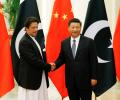
Gilgit Baltistan's large frontage with Kashmir and Ladakh across Kargil and the Siachen Glacier gives Pakistan and China the perceived scope for conduct of collusive operations against India and wrest control of the major course of the Indus and Shyok, observes Lieutenant General Syed Ata Hasnain (retd).

Bengal, where the electoral discourse has mostly steered clear of divisive agenda, has been drawn into the vortex with the TMC and the BJP accusing each other of fanning communal sentiments ahead of elections.

'If there is one certainty in this visit, it is that Trump does not follow a script. He is unpredictable,' highlights Ambassador B S Prakash.
'India appears to have stood its ground on strategic autonomy by resisting US pressure on Russia, China and Iran, but succumbed to the temptation to walk into a tighter embrace in defence cooperation, a high priority of the Trump administration,' notes Ambassador T P Sreenivasan.
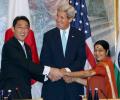
Amid China's growing assertiveness in South China Sea, India, Japan and the US at their first ever trilateral ministerial dialogue in New York.

'Under the more strident Modi version of Hindutva, Nehru has almost become a contemporary political figure.' 'The ruling party knows that without total erasure and distortion of Nehru, their fantasies will always be wobbly.'

Democracy in Maldives is at the crossroads. There is need for the international community to put pressure on the incumbent regime in the country, so that it is not able to disrupt elections once again, and the democracy in Maldives could be saved from sinking, says Anand Kumar.

Swaraj expressed satisfaction over the agenda of the inaugural dialogue while giving the details of the deliberations.

President Pranab Mukherjee's recent visit to the Pacific Island nation is path-breaking, but much more needs to be done, says Dr Rahul Mishra.

In a blow to Italy's attempt to internationalise the case of two Italian marines being tried in India for killing two fishermen, UN Secretary-General Ban Ki-moon has asked Rome to resolve the issue bilaterally.

A round-up of our favourite photographs from the week gone by

'The past year has yielded extraordinary results in the strategic, commercial, and people-to-people components of the India-United States partnership, US Ambassador to India Richard Rahul Verma tells Aziz Haniffa/Rediff.com in an exclusive interview.

Indonesia is not even counted as a next-door neighbour of India, though the southern-most tip of India is less than a hundred miles away from the northern-most tip of Indonesia. Bringing Indonesia back in the mainstream of the Indian strategic calculus is a step long overdue, says Dr Rahul Mishra.
'India needs to learn in Kashmir how to spread development.' 'Pakistan needs to learn in Balochistan how to spread development.' 'China needs to learn in Xinjiang and Tibet.' 'And if they can show tangible benefits, there will be less terrorism.' 'No one wakes up in the morning saying 'I want to kill myself', right?'

Several homes, businesses and mosques in the hilly Kandy district have been damaged in anti-Muslim riots.
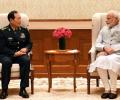
'China's military is expected to deploy full throttle its new equipment including J-20 stealth fighters, drones, medium range missile systems, surveillance and others to continue to put psychological pressure on India,' warns Srikanth Kondapalli, Professor in Chinese Studies, JNU.

China is opposed to India's oil exploration in the South China Sea because it is a disputed area, but regards its ambitious US $46 billion (Rs 2.9 lakh crore) economic corridor through Pakistan-occupied Kashmir a "livelihood project" with issues left over from history.
'The world does not care about the tension on our border.' 'India has to emerge as a strong economic power.' 'Respect comes when the world sees a country with a direction and leadership that has a vision,' points out Ramesh Menon.

It will not be to India's advantage to create misperceptions that it is bandwagoning with some Anglo-American project for regime change in Myanmar, argues Ambassador M K Bhadrakumar.

A leading US daily describing nuclear-armed Pakistan as "unquestionably the biggest concern" to stability in South Asia.

'Today the Chinese think they can slap India, and there will be no consequences.' 'They must be made to feel the consequences through any and all means,' says Rajeev Srinivasan.
